
Can AI EdTech support schools implementing the Writing Framework?
Dr Tim Mills MBE, lead advisor on the DfE Writing Framework, in conversation with the team at Olex.
When Dr Tim Mills was drafting the Writing Framework, a question kept surfacing: if AI can compose better than most adult writers, what is the point of teaching children to write at all?
His answer is clear – and it has significant implications for how schools should think about AI in the writing classroom.
Writing is irreplaceable – and here’s why
There are two reasons why AI cannot and should not replace the act of writing.
The first is cognitive. Writing makes us smarter. According to psychologist Ronald Kellogg, quality writing demands quality thinking – more so than reading, where the writer has already done the heavy lifting. Writing is also metacognitive: we cannot translate ideas into words without examining our own thinking. And crucially, when we write something rather than simply read it, we remember it far more vividly.
The second reason is that AI is entirely dependent on human writing. It can imitate existing work – but it cannot invent. As creativity researcher Mark Runco puts it, AI does not choose to produce novelty. Humans make choices; programmes make decisions. Only humans have epiphanies.
This is why the Writing Framework includes the line: “When writers abdicate composition to artificial intelligence, none of these cognitive advantages apply.”
The key word is abdicate. Handing over the act of composition – to AI or to anyone else – removes the cognitive benefit entirely. But getting support with your writing is something different altogether.
The distinction that matters
Tim offers a useful illustration. Imagine a child working on a geography essay. If their Mum writes it for them, the cognitive benefit is lost. But what if Mum checks their sentences, suggests better vocabulary, helps them structure their argument? That is not abdication – that is support. And if we replace Mum with a teacher, we would call it good pedagogy.
What if that support were provided by AI – consistently, accurately, immediately, for every child in the class?
The research is increasingly clear on this. Automated feedback that is close to the point of writing improves writing quality. It is consistent in a way human feedback cannot always be. And for developing writers, it removes the perceived subjectivity of teacher feedback, which evidence suggests can actually increase motivation.
Where AI fits within the Framework
So where specifically can AI support schools implementing the Writing Framework? Tim identifies four areas.
Early writing and text structure
Children build mental models of text structure from a very young age – and the stronger those models, the better they will write when transcription catches up. Narrative models develop quickly because children are immersed in stories early. Non-narrative models take far longer, yet they are critical for disciplinary writing in secondary school.
AI is well suited to making these structures visible. Identifying the orientation of a story, the conflict, the resolution; revealing the architecture of an information text before a child attempts to write one. This is foundational work that is often left too late.
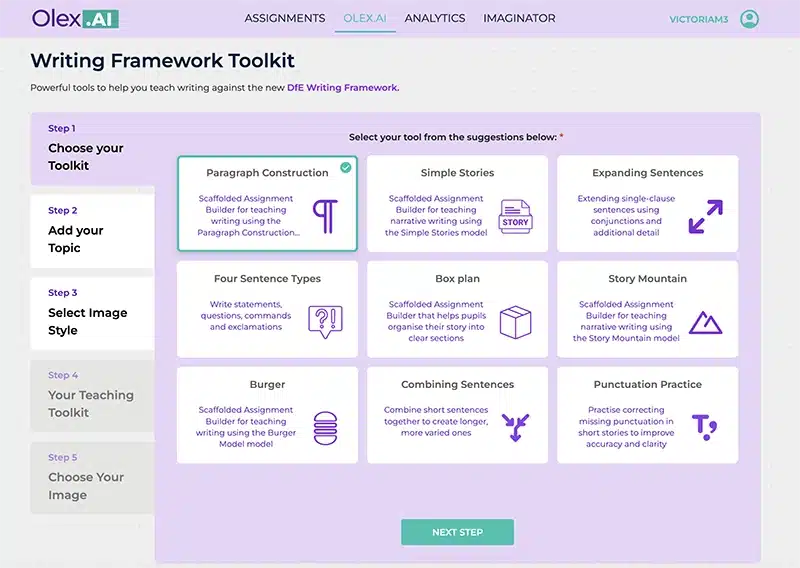
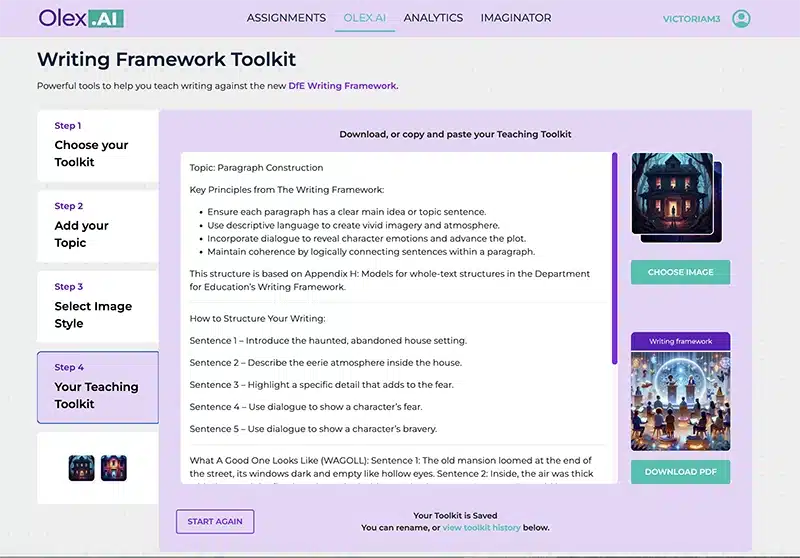
At Olex, we address this through tools that allow teachers and pupils to co-construct text models – story mountains, paragraph structures, whole-text frameworks – and keep those models visible throughout the writing process. Teachers can annotate them live, share them across a class or cohort, and return to them in later units of work. Pupils become active participants in building “what a good one looks like”.
Transcription: handwriting and spelling
Handwriting and spelling are the two transcription skills that appear consistently in the research as obstacles to effective writing. The sooner children automate them, the sooner their working memory is free to attend to sentences and composition.
Systematic, consistent instruction is essential – and AI is well placed to deliver it. OlexAnalytics tracks both spelling accuracy and frequency across every child, class, and year group. Leaders can see immediately who is secure, who is slipping, and where targeted support is needed – without relying on inconsistent teacher judgements or time-consuming manual checks.
OlexFeedback gives pupils immediate, precise guidance at the point of writing: a prompt to correct a high-frequency word, tackle a tricky spelling pattern, or refine punctuation. Routine but vital monitoring is handled consistently, freeing teachers to focus on the more complex pedagogical work.
Sentence development
The Framework is explicit: sentences are the building blocks of writing. Without sentence control, pupils cannot build coherent paragraphs or extended texts.
The most robust research on improving sentence structure points to sentence combining – taking two or more simple sentences and joining them in a range of ways. The challenge for teachers is generating relevant activities connected to the texts pupils are actually studying, at the right level, for the right children.
OlexTeach makes this systematic. Teachers can quickly generate sentence-level tasks anchored to whatever pupils are reading – building compound sentences from a recount, adding subordinate clauses to a diary entry. OlexFeedback provides personalised next steps in real time. OlexAnalytics tracks whether pupils are secure with simple sentences, beginning to vary their structures, or confidently manipulating complex clauses. As Tim puts it: “The building of quick and effective sentence combining activities is not only a time-saver for teachers but has real power for developing sentence structure competence.”
Composition
Composition is not a linear process. Writers plan as they draft, edit as they write, and revise their plans as they go. Tim identifies four of the five phases where AI can add genuine value.

In the planning phase, AI can support goal-setting, surface relevant vocabulary and content knowledge, and help pupils see the whole structure of what they are about to write – including where paragraphs sit and how a model text maps onto a plan.
In the drafting phase, pupils should be left to write. As Tim notes, the draft is where the cognitive work happens.
In the revising phase – where Kellogg’s research suggests writers experience the greatest cognitive load – AI can provide consistent, accurate feedback in the moment. Teachers are expert at qualitative, subjective feedback; AI handles the consistent, objective layer. Together they give pupils more complete support than either could alone.
In the editing phase, AI excels at the secretarial work: proofreading for spelling, punctuation, and accuracy.
At Olex, we build this cycle into everything. Pupils draft with their scaffolds available. They submit and receive framework-aligned feedback that highlights strengths and defines next steps. Teachers review before anything reaches a pupil. And then – the part children talk about – their writing becomes something. OlexStorybooks turns finished pieces into illustrated publications. For children who have learned that writing only exists to be marked, becoming a published author changes the relationship with writing entirely.
What this means for leaders
Tim is clear that AI should not attempt the qualitative, subjective elements of writing assessment – originality, creativity, voice. Those judgements belong to teachers.
But where objective criteria need to be assessed consistently, accurately, and at scale – sentence structure, spelling, punctuation, paragraph cohesion – AI is not just useful. It is, in several respects, more reliable than manual assessment.
For school leaders, this matters for pupil progress meetings, moderation, CPD targeting, and trust-level reporting. As Tim puts it: “Rather than the catch-all ‘his writing is weak’, leaders and teachers can focus on those aspects that are actually weak and may be inhibiting composition.”
OlexAnalytics gives leaders a consistent, framework-based view across classes, schools, and cohorts. Writing, for the first time, becomes trackable in the same way that reading and maths have been for years.
A final thought from Tim
“AI cannot and should not replace the writing process. There are too many cognitive benefits to be gained from learning to write – and from writing. But where it comes into its own, and where it not only helps teacher workload but actually improves outcomes, is where objective criteria need to be assessed in large amounts of text, and where consistency, accuracy, and immediacy are essential.”
That is the case Olex was built on. And it is the case the Writing Framework itself supports.
Working with Dr Tim Mills MBE, we developed the Olex DfE Writing Framework PowerPack – an all-in-one toolset giving schools both the guidance and practical tools they need to navigate the new framework with confidence. Find out more.